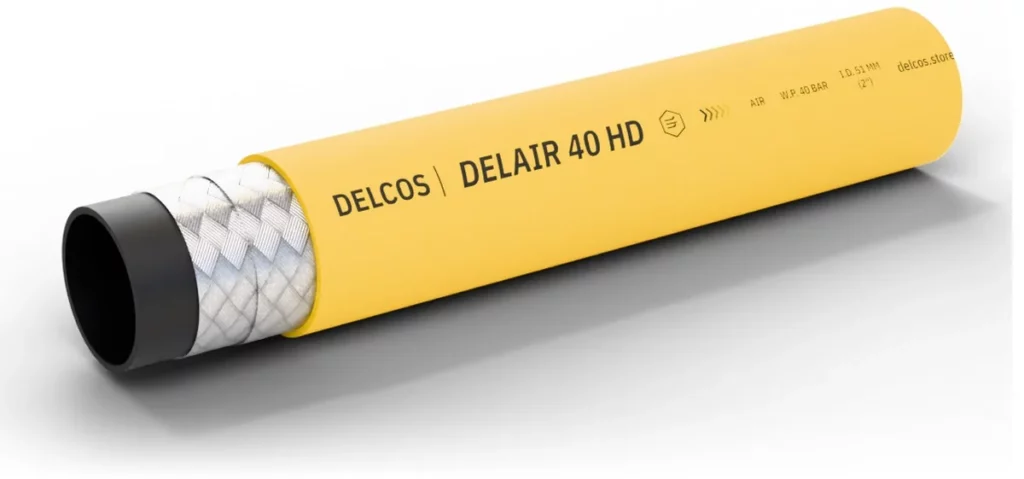
Selection
How to choose an air hose for a compressor and pneumatic tools
Pressure class, inner diameter, length, oil mist and temperature: what to check when choosing an air hose for a compressor and pneumatic tools.
Why a motor pump needs a hose with a steel helix on the suction side, how to match the hose to the pump inlet and how to keep the suction line working.
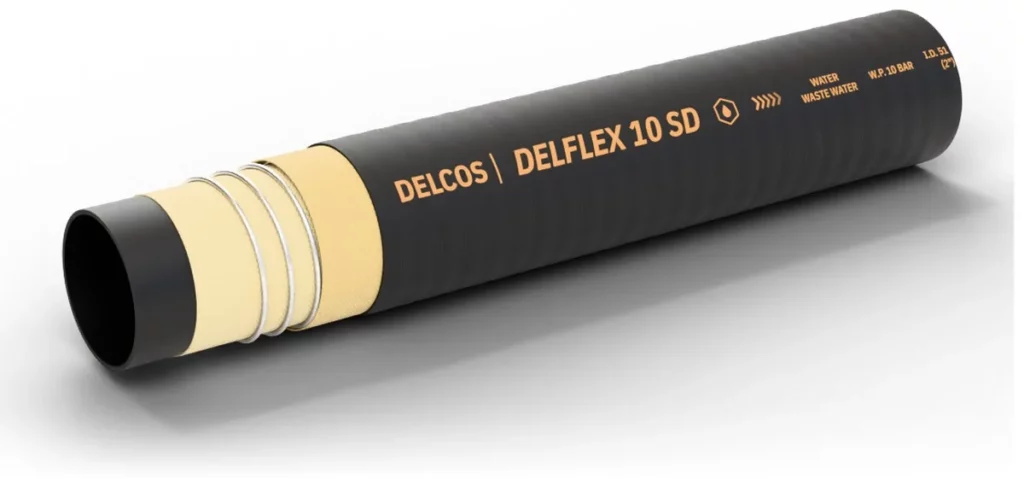
A motor pump works with two hoses: a suction hose from the water to the pump inlet and a delivery hose from the pump outlet to where the water goes. Most problems start on the suction side: if the hose flattens under vacuum or lets air in, the pump loses its prime and its output drops. Here is how to choose a suction hose that works.
On the suction side the pump works with vacuum: the pressure inside the hose is lower than outside. A hose with textile reinforcement only, or a layflat hose, flattens under these conditions. A suction hose has a steel helix in the wall that keeps it round. DELFLEX 10 SD is built this way: textile reinforcement and a steel helix, rated for vacuum from 0.5 to 0.9 bar depending on the size and for delivery up to 10 bar as well.
On the delivery side the hose is under pressure, and a helix is not needed. There you can use DELFLEX 10 D, a strong and very flexible delivery hose for ID 6–60 mm, or a layflat hose, which rolls flat for transport.
Motor pumps are sized by the diameter of the inlet and outlet, usually given in inches. The suction hose should have the same inner diameter as the pump inlet. A narrower hose increases friction losses on the suction side and reduces the flow.
| Pump connection | Hose ID |
|---|---|
| 2″ | 51 mm |
| 2½” | 63.5 mm |
| 3″ | 76 mm |
| 4″ | 102 mm |
| 6″ | 152 mm |
All these sizes are available in DELFLEX 10 SD; DELFLEX 10 D goes up to ID 60 mm.
A pump can lift water on the suction side only to a limited height. In theory, atmospheric pressure lifts water about 10 m; in practice the limit is lower, and every pump has its own maximum suction lift given in its manual. Friction in the suction hose takes away part of this height. So the suction hose should be as short as the job allows, and the pump should stand as close to the water level as possible. Long distances are better covered on the delivery side.
Air that enters the suction line breaks the vacuum. Tighten couplings and clamps, check the seals, and do not use a hose with a damaged inner tube or cover. A strainer at the inlet end of the hose keeps stones and debris out of the hose and the pump.
DELFLEX 10 SD is made for water, waste water and inert fluids and works from −30 to +80 °C. For water with a lot of sand or mud, consider a hose made for abrasive media: DELHD 5 CR is a flexible, vacuum proof hardwall hose for mud, sand and blasting media, ID 51–150 mm. See also other abrasive hoses.
We cut DELFLEX 10 SD and DELFLEX 10 D to length from coils and fit couplings: see hose crimping and assembly. Send us the details via the contacts page.
See also: How to order a hose assembly: what we need to know.
Selection
Pressure class, inner diameter, length, oil mist and temperature: what to check when choosing an air hose for a compressor and pneumatic tools.
Selection
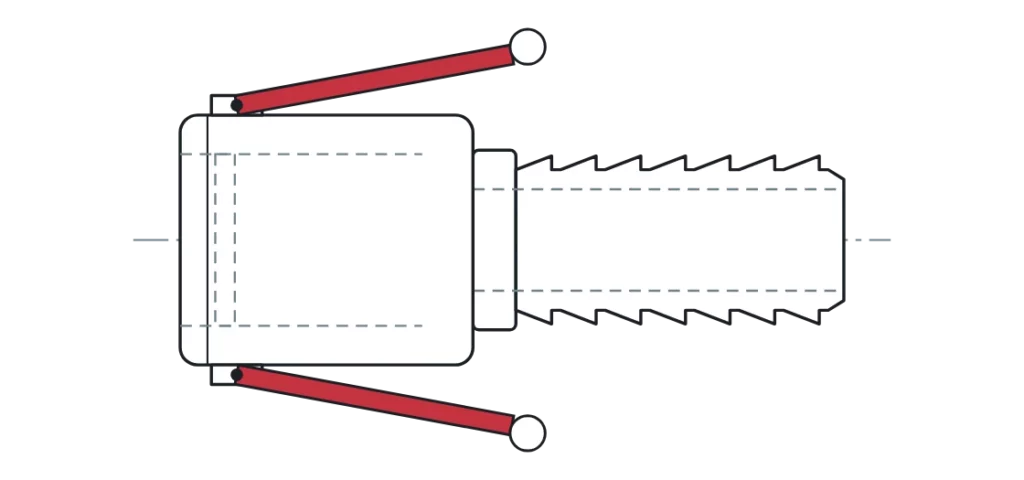
Which half of the coupling each Camlock type is, what is on its other end, how the types connect, and which sizes and materials are available.
Applications
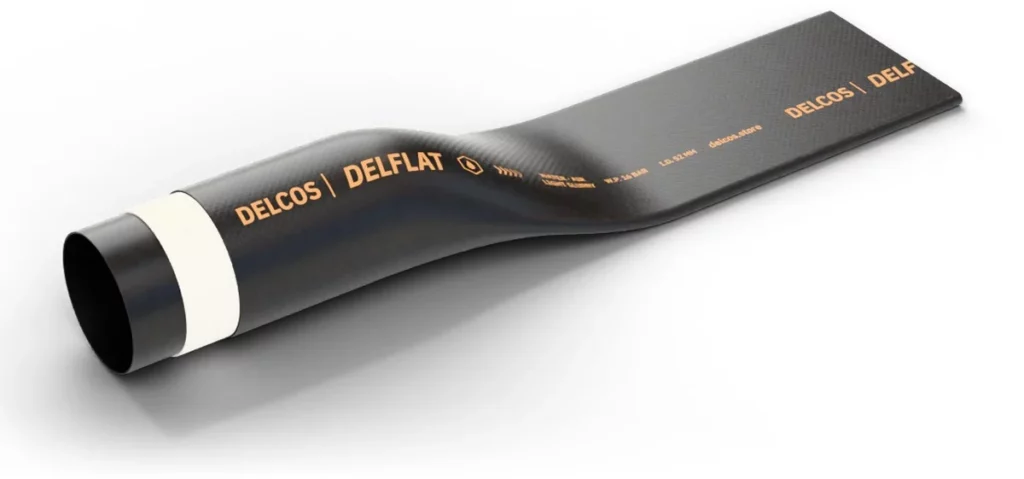
Surface or submersible pump, layflat or rubber discharge line, water with sand and mud: how to put together hoses for pumping water out of pits and trenches.
Send us the parameters — we will select the series and couplings.